

Pakistan’s Emigration Policy in a Changing Labour Market
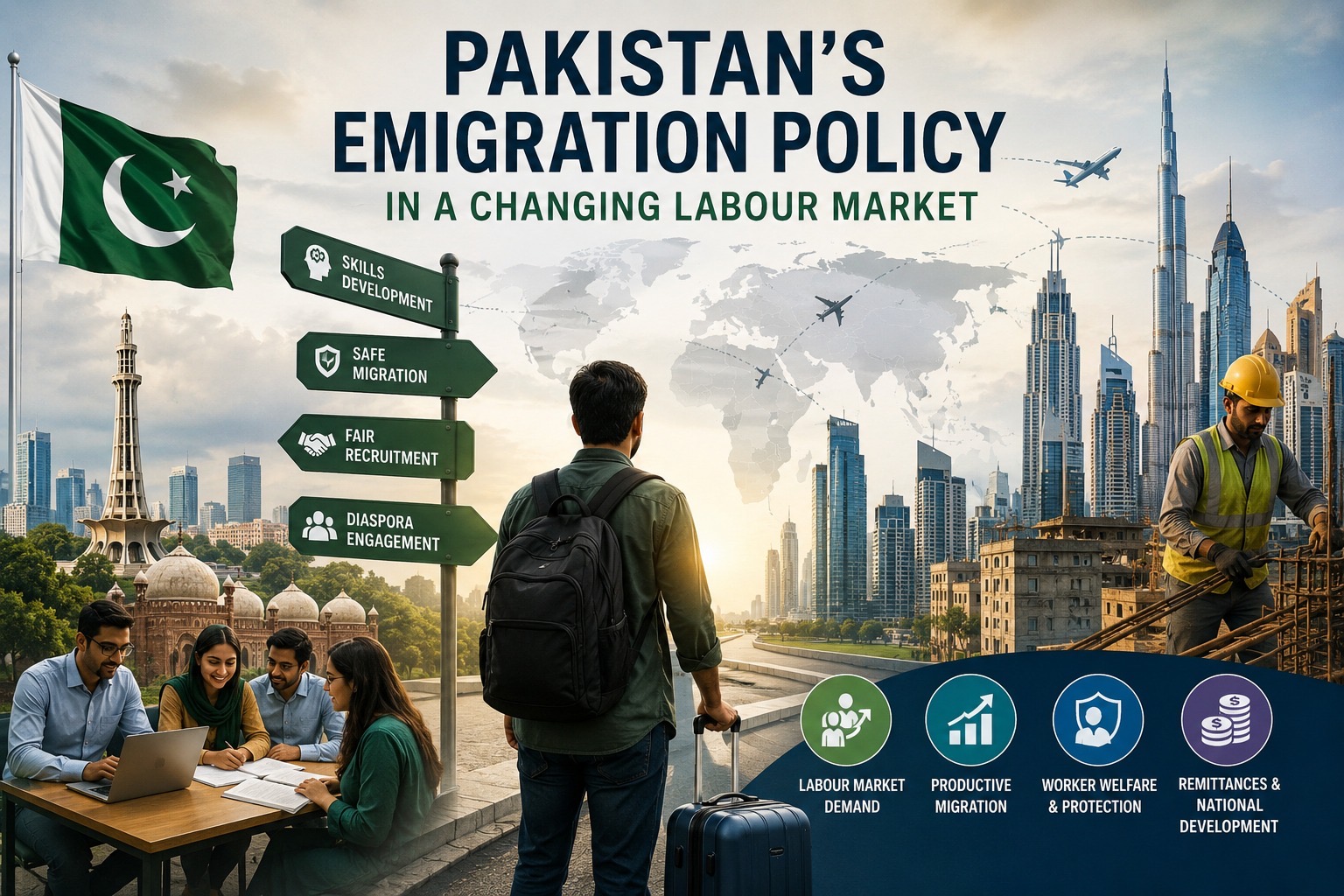
On 23 July 2026, the Government of Pakistan launched its first National Emigration and Welfare Policy 2026, marking a major shift in the country’s approach to labour migration. The policy was funded by the European Union and implemented in collaboration with the International Centre for Migration Policy Development (ICMPD). The five key pillars of the policy are: (i) promoting safe, orderly, and regular emigration; (ii) skills development; (iii) protection and welfare; (iv) diaspora engagement; and (v) return and reintegration. In a world where labour markets are increasingly becoming digital, automated, and AI-driven, this policy can help Pakistan diversify and upgrade its labour force to meet evolving global demand.
Labour migration has always been a major part of Pakistan’s economy, contributing significantly to the country’s macroeconomic stability. In FY2026, remittances from Pakistani workers reached a record US$41.6 billion, representing an increase of 8.6 per cent over the previous fiscal year. However, Pakistan’s overseas workforce remains overwhelmingly concentrated in the Gulf Cooperation Council (GCC) countries. In 2025, more than 92 per cent of all registered emigrants moved to GCC countries, while during the first half of 2026, up to June, nearly 89 per cent of total registered emigrants continued to head to the region. Saudi Arabia remained the largest destination, followed by the United Arab Emirates, Qatar, Bahrain, Oman, and Kuwait.
While the Gulf remains the primary destination for Pakistani emigrants, the quality of the labour force it receives is not encouraging. Saudi Arabia is the largest destination for Pakistani workers and receives a predominantly low-skilled workforce. In 2023, more than half (52.7 per cent) of Pakistani workers migrating to Saudi Arabia were classified as unskilled, while only 1.3 per cent were categorised as highly skilled or highly qualified.
Although this labour flow to the GCC has generated substantial remittances for Pakistan, sustaining it will become increasingly difficult because of the growing global demand for highly skilled labour driven by technological advancements. As Gulf countries shift towards digitalisation, automation, and artificial intelligence, demand is rapidly increasing for highly qualified workers with advanced digital and technical skills, as well as expertise in education, healthcare, and renewable energy.
This transformation is already reflected in the ambitious national development plans adopted by several Gulf countries. Saudi Arabia’s Vision 2030 focuses on reducing dependence on the oil economy by moving towards advanced manufacturing, biotechnology, mining, tourism, and sports, while simultaneously accelerating digital transformation through 5G infrastructure and smart city development. As a result, Saudi Arabia’s transition towards a knowledge-based economy is increasing demand for ICT professionals, engineers, healthcare professionals, renewable energy specialists, and scientists.
Similarly, the UAE Digital Economy Strategy aims to double the contribution of the digital economy to GDP from 9.7 per cent in 2022 to 19.4 per cent within the next ten years. The strategy focuses on accelerating digitalisation across various economic sectors, thereby creating demand for a highly skilled workforce with expertise in artificial intelligence, cybersecurity, data analytics, and cloud computing.
Likewise, Qatar National Vision 2030 outlines a policy framework for investing in human capital through healthcare, education, research, and innovation, while promoting environmental sustainability through renewable energy and resource conservation. Consequently, Qatar’s labour market is expected to require highly skilled professionals in these fields.
These national transformation strategies reveal that the labour market in the Gulf region is undergoing a radical shift, driven not only by digitalisation but also by ongoing regional conflicts. This presents an opportunity for Pakistan to strengthen its skills development institutions and build market-driven skills that will be valuable for post-war reconstruction as well as the Gulf’s long-term economic transformation.
The National Emigration and Welfare Policy 2026 provides an important framework, but its success will depend on how effectively institutions coordinate their efforts and develop skills that meet labour market demand. To diversify Pakistan’s overseas workforce, the government needs to strengthen the capacity of the National Vocational and Technical Training Commission (NAVTTC) as the principal coordinating body of the national skills ecosystem. The International Labour Organization’s Skills Profile for Pakistan revealed policy- and programme-level institutional duplication between NAVTTC and provincial Technical Education and Vocational Training Authorities (TEVTAs). NAVTTC’s National Skills for All Strategy (NSAS) also reports fragmentation in curriculum development, training, and certification across federal and provincial TVET institutions. Furthermore, the ILO highlights weak labour market intelligence, limited employer engagement, and insufficient understanding of changing labour market demands.
Improved coordination between NAVTTC, provincial TEVTAs, and other training institutions would enable Pakistan’s skills development system to better respond to the evolving requirements of global labour markets. Similarly, establishing a national labour market intelligence system in partnership with the Bureau of Emigration and Overseas Employment (BE&OE) would further strengthen evidence-based skills planning.
Given the current global context, the National Emigration and Welfare Policy 2026 provides a timely opportunity for Pakistan to shift its policy focus from exporting labour in bulk to developing a competitive workforce for the international job market. However, its lasting impact will ultimately depend on the extent to which the country’s skills development system is aligned with the evolving requirements of the global labour market.
Disclaimer: The views and opinions expressed in this article are solely those of the author and do not necessarily reflect the editorial stance, policies, or official position of The Spine Times.


