

Pakistan’s Missing Classrooms
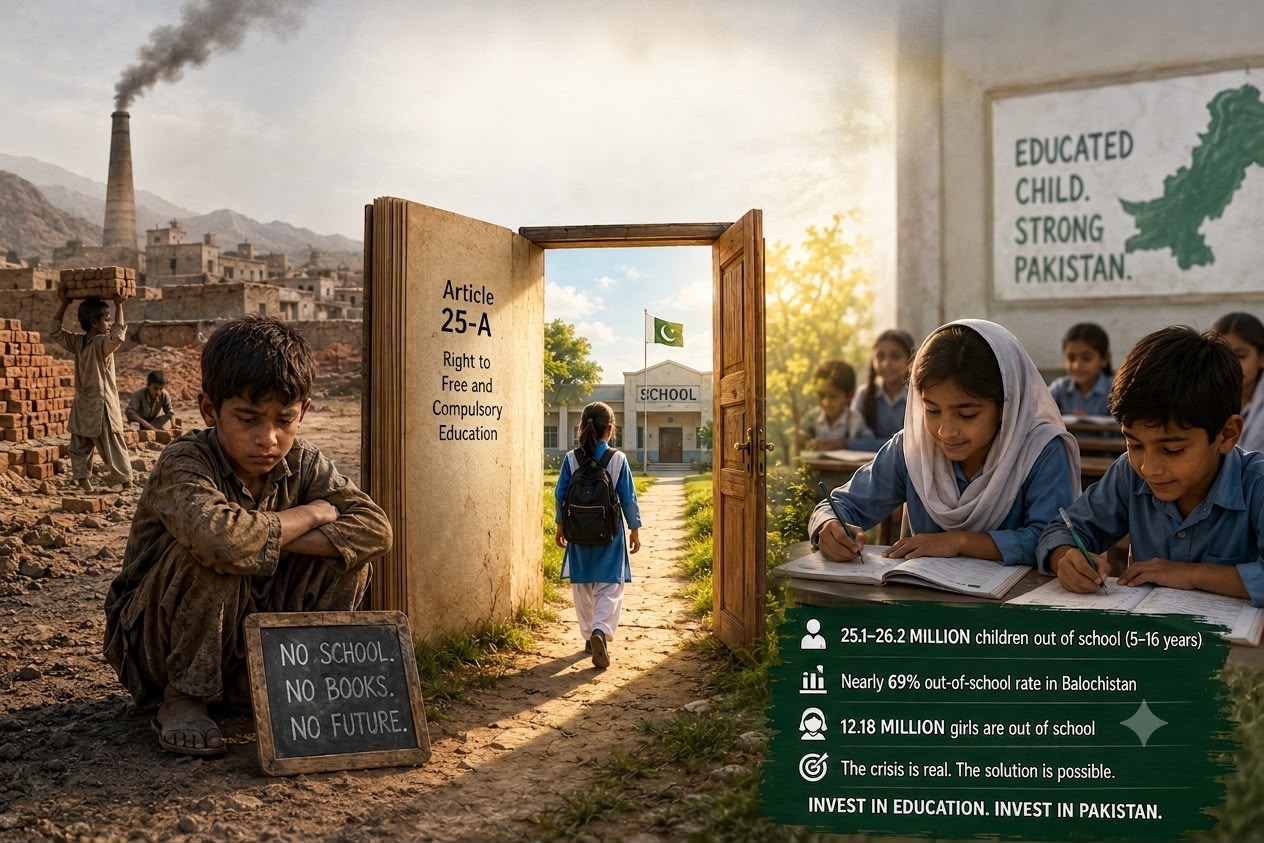
For more than 25 million Pakistani children, the school bell never rings. Their absence from classrooms is not merely an education statistic; it is a measure of the opportunities Pakistan is allowing to disappear. According to the latest Pakistan Education Statistics 2023–24, published by the Pakistan Institute of Education (PIE), an estimated 25.1 to 26.2 million children aged 5–16 are out of school, representing more than one-third of the country’s school-age population. This alarming reality constitutes a direct violation of Article 25-A of the Constitution, which guarantees every child the fundamental right to free and compulsory education. More importantly, the crisis extends far beyond the education sector. It is an economic, social, and national development crisis that undermines human capital formation, widens inequality, and threatens Pakistan’s long-term prosperity.
The crisis is unevenly distributed across the country. Punjab has the largest number of out-of-school children, at 9.69 million, largely because it is Pakistan’s most populous province. Sindh follows with 7.39 million, Khyber Pakhtunkhwa with 4.50 million, and Balochistan with 3.48 million. However, when measured as a proportion of the school-age population, Balochistan faces the deepest educational deprivation, with nearly 69 per cent of children aged 5–16 out of school. The corresponding rates are 44 per cent in Sindh, 34 per cent in Khyber Pakhtunkhwa, 27 per cent in Punjab, and only 15 per cent in Islamabad. These figures reveal that the crisis is not merely a matter of population size; it is fundamentally a problem of unequal access to educational opportunities.
Gender disparities further compound the problem. According to Pakistan Education Statistics 2023–24, approximately 12.97 million boys and 12.18 million girls aged 5–16 are out of school nationwide. Nationally, the numbers of out-of-school boys and girls are relatively similar, but provincial trends tell a different story. Punjab records more out-of-school boys than girls, whereas Sindh and Khyber Pakhtunkhwa have significantly more girls excluded from education. In many rural and marginalized areas, cultural norms, early marriage, insecurity, and shortages of female teachers continue to prevent girls from attending school. Unless these structural barriers are addressed, Pakistan will struggle to achieve gender equality in education.
The crisis also has a distinct geographical dimension. Educational deprivation is concentrated in the country’s poorest and most marginalized districts. South Punjab, interior Sindh, the mountainous regions of Khyber Pakhtunkhwa, and much of Balochistan consistently record the highest out-of-school rates. Districts such as Rajanpur, Thatta, Kohistan, Sherani, and Shaheed Sikandarabad continue to perform poorly, while many urban districts report comparatively higher enrolment. These disparities highlight the need for district-specific policies rather than uniform provincial interventions.
The reasons behind this persistent crisis are well known. Poverty remains one of the largest barriers to education. Although public schooling is officially free, millions of families cannot afford indirect costs such as uniforms, books, transportation, and examination fees. For many households, especially in rural areas, sending children to work in agriculture, brick kilns, domestic labour, or informal businesses becomes an economic necessity. Child labour and school exclusion therefore reinforce each other, trapping families in an intergenerational cycle of poverty.
Weak educational infrastructure further worsens the situation. Many rural communities lack middle and secondary schools, forcing children to discontinue their education after completing primary grades. Basic facilities, including boundary walls, toilets, electricity, clean drinking water, and safe classrooms, remain unavailable in thousands of public schools. The continued existence of ghost schools and teacher absenteeism further undermines public confidence in the education system.
Natural disasters and conflict have added another layer of complexity. The devastating floods of recent years damaged thousands of schools across Pakistan, while insecurity in conflict-affected areas disrupted learning for many children. Climate-related disasters are increasingly threatening educational continuity, particularly in vulnerable districts where reconstruction remains slow.
Equally concerning is the quality of governance. Despite the declaration of a National Education Emergency, progress has remained limited. A large share of education spending continues to be absorbed by recurrent expenditures, leaving inadequate resources for infrastructure, teacher development, learning materials, and quality improvement. Without stronger accountability and better allocation of resources, increased spending alone will not deliver better educational outcomes.
Pakistan’s education challenge is also alarming when viewed in a regional context. Among South Asian countries, Pakistan has one of the highest proportions of out-of-school children. Countries such as Bangladesh and Nepal have significantly improved school participation through sustained investments in primary education, targeted support for disadvantaged households, and stronger accountability mechanisms. India has also substantially reduced educational exclusion through large-scale reforms and increased public investment. Pakistan can learn valuable lessons from these experiences while designing solutions suited to its own context.
Addressing the out-of-school children crisis requires a shift from broad national targets towards focused, evidence-based interventions. First, public investment should prioritize districts with the highest levels of educational deprivation rather than distributing resources uniformly across provinces. Second, expanding middle and secondary schools is essential to prevent children from dropping out after primary education. Third, recruiting and retaining female teachers must become a national priority, particularly in remote and conservative communities where their presence can directly influence girls’ enrolment. Fourth, financial barriers should be reduced through targeted cash transfers, school meals, free textbooks, transportation support, and conditional education stipends for vulnerable households. Finally, stronger governance is needed through digital monitoring, improved school management, rehabilitation of ghost schools, and greater community participation in school oversight.
Pakistan’s demographic dividend will only become an economic dividend if today’s children receive quality education. Every child who remains out of school represents lost human capital, lower future productivity, weaker economic growth, and greater social inequality. The country’s ambitions for sustainable development, technological advancement, and inclusive growth cannot be achieved while millions of children remain excluded from classrooms.
The challenge is enormous, but it is not insurmountable. Pakistan already knows where the problem is most severe and what policies are needed to address it. What is required now is political commitment, sustained public investment, and effective implementation. Bringing 25 million children into school is not simply an education policy objective. It is one of the most important investments Pakistan can make in its future prosperity, social cohesion, and national development.
Disclaimer: The views and opinions expressed in this article are solely those of the author and do not necessarily reflect the editorial stance, policies, or official position of The Spine Times.


